
American Pottery Art
Online information about American Ceramic Tile Art from sources other than Resource Library
with an emphasis on representational art
page 3
Nude Vases, Cubist Faces: Modernism at Rookwood Pottery is a 2014-15 exhibit at the Dubuque Museum of Art which says: "The exhibition Nude Vases, Cubist Faces: Modernism at Rookwood Pottery from the collection of Riley Humler and Annie Bauer will showcases select works from the Rookwood Pottery Company from 1929, the year that Jens Jacob Herring Krog Jensen joined Rookwood until 1948 when he and his wife Elizabeth Barrett, also a Rookwood decorator, left the company to become independent artists." Accessed 3/17
Potteries of California includes biographies of potters and other historic information. Accessed August, 2015.
"Pottery" is an online artcle about the history of art pottery in Collectors Weekly. Accessed August, 2015.
Pueblo Dynasties: Master Potters from Matriarchs to Contemporaries is a 2019 exhibit at the Crocker Art Museum which says: "Featuring more than 200 pieces by premier potters, this exhibition focuses on legendary matriarchs such as Nampeyo, Maria Martinez, and Margaret Tafoya, as well as many of their adventuresome descendants, whose art has become increasingly elaborate, detailed, personal, and political over time." Also see 10/24/19 Incollect article by Scott Shields. Accessed 5/20
Robert Briscoe / Walter Gropius Master Artist Series is a 2013 exhibit at the Huntington Museum of Art which says: "For more than 40 years, Robert Briscoe's functional pottery has explored the powerful link between maker and user by emphasizing the integral role that handmade ceramic objects play in savoring some of life's richest experiences." Accessed 3/17
"Rosemeade" by Linda & Bill Bakken, from an article that appeared in WPA Press, Vol. 16, Spring 2003. Accessed November, 2015.
Sculpting Nature -The Favrile Pottery of L.C. Tiffany, an exhibit held February 03, 2004 through January 09, 2005 at the Charles Hosmer Morse Museum of American Art. Includes Gallery Guide (PDF), Object Guide (PDF). Accessed July, 2014
Southern Migration: Ruby's @ AMOCA is a 2013 exhibit at the American Museum of Ceramic Art which says: "Ruby's Clay Studio & Gallery is a dynamic community of 100 resident artists who create a broad array of functional tableware, decorative vessels, sculpture, wall and garden art using both traditional and innovative techniques in wheel-throwing and hand-building methods. In a supportive and collegial atmosphere, Ruby's nurtures people new to ceramics, hobbyists, budding professionals, production potters and nationally recognized artists. People come from all over the Bay Area to learn and work." Accessed 10/18
Southwestern Native American Pottery
Cochiti Pottery in the Early Twentieth Century:is a Gemini 3 Pro Deep Research Report which says: "The cultural and artistic evolution of the Cochiti Pueblo during the early twentieth century represents one of the most sophisticated responses to colonialism and the commodification of indigenous identity in the American Southwest. At the heart of this transformation was the interaction between Cochiti potters and the expansive tourism infrastructure developed by the Fred Harvey Company, specifically through the "Indian Detours" program. This period, stretching roughly from the arrival of the railroad in 1880 to the onset of World War II, saw the birth of a unique figurative tradition known as monos, characterized by a blend of traditional materials and radical social commentary. The development of these figures was not merely a commercial endeavor but a complex act of cultural preservation and quiet subversion, as potters utilized the very tourists who purchased their wares as subjects for satirical critique." Accessed 3/26
Hopi Pottery in the Early Twentieth Century is a 2026 Gemini 3 Deep Research Report which says: "The cultural landscape of the American Southwest underwent a seismic shift at the dawn of the twentieth century, catalyzed by the expansion of the Atchison, Topeka & Santa Fe Railway and the commercial ingenuity of the Fred Harvey Company. Within this period of rapid modernization and burgeoning tourism, the Hopi potters of First Mesa, most notably led by the visionary artist Nampeyo of Hano, developed a distinctive aesthetic and technical style that fundamentally redefined indigenous ceramic traditions. This evolution was not a spontaneous artistic movement but rather a calculated and sophisticated response to the socioeconomic pressures of the era and the specific demands of a new class of travelers arriving on the "Indian Detours." By bridging the gap between the archaeological past and the commercial present, these artisans synthesized ancestral materials and motifs into a characteristic style that appealed to a global market while simultaneously preserving their cultural heritage during a time of profound transition." Accessed 3/26
San Ildefanso Pottery in the Early Twentieth Century is a 2026 article by Gemini 3 which says: "The high desert sun of New Mexico casts long, amber shadows over the adobe walls of San Ildefonso Pueblo, a place where the earth itself has always been the primary medium of expression. In the early years of the twentieth century, this small Tewa-speaking community sat at a quiet crossroads of history. The ancient traditions of pottery making, which had sustained the Pueblo people for a millennium, were facing a slow decline. For generations, the women of San Ildefonso crafted sturdy, utilitarian vessels -- broad-shouldered ollas for water storage and wide bowls for grain -- but the arrival of inexpensive, mass-produced metal pails and enamelware from the burgeoning American industrial machine began to render these clay tools obsolete. It was during this fragile period of transition that a remarkable convergence of archaeology, tourism, and individual artistic genius would transform San Ildefonso pottery from a fading domestic craft into a world-renowned fine art." Accessed 3/26
Santa Clara Pueblo Ceramics in the Fred Harvey Era is a 2026 Gemini 3 article which says: "The early twentieth century served as a transformative epoch for the Santa Clara Pueblo, a Tewa-speaking community situated along the Rio Grande in northern New Mexico. During this period, the production of pottery underwent a profound metamorphosis, transitioning from a localized, utilitarian practice rooted in millennia of communal tradition to a sophisticated art form curated for a burgeoning global tourist market. This shift was catalyzed by the strategic interventions of the Atchison, Topeka and Santa Fe Railway and its hospitality partner, the Fred Harvey Company. Through the establishment of the Indian Department in 1901 and the subsequent launch of the "Indian Detours" in 1926, these corporate entities did not merely facilitate travel; they actively participated in the aesthetic and economic reshaping of Pueblo life." Accessed 3/26
Sky City Crucible: Acoma Pottery in the Era of Fred Harvey Indian Detours is a 2025 article by Gemini 3 which says: "The high desert plateau of western New Mexico serves as a landscape where the ancient and the modern have engaged in a century-long dialogue, mediated through the tactile medium of clay. At the heart of this cultural intersection lies the Acoma Pueblo, or Sky City, a settlement perched atop a 370-foot sandstone bluff that has remained continuously inhabited for over a millennium. By the dawn of the twentieth century, this ancestral stronghold became the focal point of a transformative economic and artistic movement, driven by the expanding reach of the Atchison, Topeka and Santa Fe Railway and the sophisticated marketing machinery of the Fred Harvey Company. The development of Acoma pottery during this period was not merely a continuation of domestic craft but a deliberate evolution of style, materials, and motifs designed to meet the expectations of a new class of travelers. These "detourists," arriving in the rugged New Mexico interior via luxury "Harveycars," sought a tangible connection to a culture they were told was vanishing, prompting Acoma potters to refine their techniques and visual language into a form that was both deeply traditional and highly marketable." Accessed 3/26
Zuni Pottery In the Fred Harvey Era is a 2026 Gemini article which says: "The early twentieth century in the American Southwest was defined by a profound collision between ancient sedentary cultures and the rapid expansion of industrial capitalism. At the heart of this transformation was the Zuni Pueblo, or A:shiwi, a community that had occupied the high desert plateaus of western New Mexico for millennia. For the A:shiwi people, the ceramic arts were never merely decorative; they were functional vessels for water and prayer, manifestations of a matrilineal tradition that linked the physical land to the spiritual realm of the ancestors. However, as the Santa Fe Railway and the Fred Harvey Company began to market the "Indian Country" to a burgeoning class of eastern travelers, the Zuni ceramic tradition underwent a strategic and stylistic evolution. This period, roughly spanning from 1895 to 1940, saw the emergence of a characteristic Zuni style that balanced the demands of a new commercial market -- fueled by the luxury "Indian Detours" -- with the internal necessity of cultural preservation." Accessed March, 2026
Susan Folwell: Through the Looking Glass is a 2019 exhibit at the Harwood Museum, University of New Mexico which says: "In Through the Looking Glass, Folwell offers audiences an opportunity to consider how narrative sequences painted on Pueblo pottery reflect a new vision of Taos Society of Artists' portraits in a 21st century context. In turn, she calls attention to the ways that Couse, Dunton, and their fellow painters humanized Native American peoples in their portraits, during a time when Indians were mythologized and regarded as dispensable." Also see 1/1/70 article in Southwest Art Accessed 1/20
Through the Eyes of the Pot, a website devoted to southwewst pueblo pottery and culture from Holmes Museum of Anthropology. Accessed August, 2015.
Tradition in Clay: Two Centuries of Classic North Carolina Pots, an exhibit held 26 December 2010 - 20 March 2011 at the Ackland Art Museum, The University of North Carolina at Chapel Hill. Accessed 4/14
Waylande Gregory: Art Deco Ceramics and the Atomic Impulse, an exhibit held May 1 - July 20, 2014 at the Canton Museum of Art . CMA says: "Waylande Gregory (1905-1971) was one of the leading figures in twentieth-century American ceramics, helping to shape Art Deco design. This exhibition is the first retrospective on the artist, highlighting more than sixty works, including paintings, glass and ceramics, most notably four Electrons from his major commission for the 1939-1940 New York World's Fair, Fountain of the Atom. ... Waylande Gregory was the first modern ceramist to create large-scale ceramic sculptures. Similar to the technique developed by the ancient Etruscans, he fired his monumental sculptures only once. To create these works of ceramic virtuosity, the artist developed a "honeycomb" technique, in which an infrastructure of compartments was covered by a ceramic "skin." Some of these figurative sculptures weighed well over one ton, and they were fired in a kiln constructed by Gregory at his home studio in Warren, New Jersey." Accessed February, 2016
Women, Art and Social Change: The Newcomb Pottery Enterprise, an exhibit held May 17, 2014 - August 31, 2014 at the Georgia Museum of Art. Includes news releases. Accessed 12/14.
"Zanesville Stoneware Company Closes After 115 Years," by James L. Murphy, Journal of the American Art Pottery Association 18, no. 6 (2002): 12-16. Includes link to .pdf file. Accessed August, 2015.
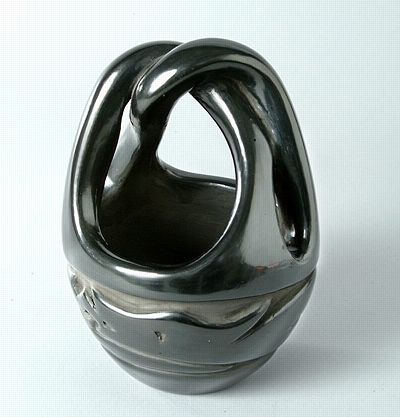
(above: Florence Browning, Double Handed Awanyu Bowl. Photo: National Park Service)
 Return to American Pottery Art
Return to Topics in American Representational Art
Links to sources of information outside of our web site are provided only as referrals for your further consideration. Please use due diligence in judging the quality of information contained in these and all other web sites. Information from linked sources may be inaccurate or out of date. TFAO neither recommends or endorses these referenced organizations. Although TFAO includes links to other web sites, it takes no responsibility for the content or information contained on those other sites, nor exerts any editorial or other control over them. For more information on evaluating web pages see TFAO's General Resources section in Online Resources for Collectors and Students of Art History.
*Tag for expired US copyright of object image:

 Search Resource Library
Copyright 2024 Traditional Fine Arts Organization, Inc., an Arizona nonprofit corporation. All rights reserved.