
Arizona Art History

with an emphasis on representational art
Other online information

(above: Gunnar Widiorss, Desert
View Watchtower, 1932, watercolor on board, Museum of Northern Arizona.
Museum of Northern Arizona. Public domain, via Wikimedia Commons)
The Amerind Museum, located in Dragoon, Arizona, says on its website: "Today, Amerind Museum exhibitions tell the story of America's first peoples from Alaska to South America and from the last Ice Age to the present. Amerind's Fulton-Hayden Memorial Art Gallery features works on western themes by such artists as Carl Oscar Borg, William Leigh, Frederic Remington, and Andy Tsihnahjinnie, and one room in the Art Gallery is reserved for the presentation of contemporary Native American art." Accessed 12/18
Arizona (sampling of artists and works connected to state) from askArt. Accessed August, 2015
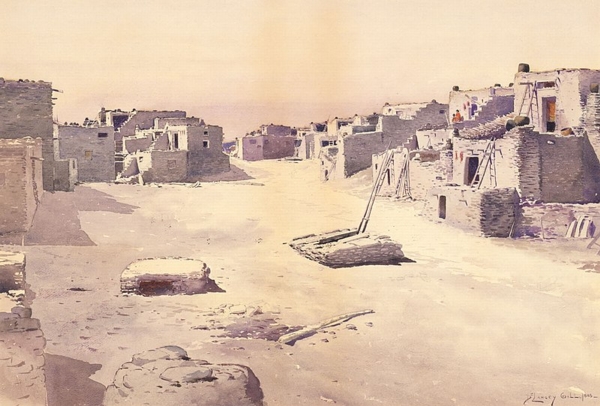
(above: De Lancey Gill, Street in the Pueblo of Oraibi, Tusayan, Arizona, 1888, 19.5 x 28 in., Smithsonian American Art Museum. Public domain, via Wikimedia Commons)
Arizona's Rich Artistic Heritage in Brief is a 2025 article by ChatGTP which says: "Arizona's rich artistic heritage has been shaped by numerous influential artists and vibrant art communities throughout its history. Here are some notable figures and movements that have left a lasting impact on the state's cultural landscape:" Accessed 4/25
Arizona Oil Painting and Sculpture: 1780-1900 is a 2025 article by Gemini AI which says: "The evolution of oil painting and sculpture in Arizona between 1780 and 1900 is a testament to the dynamic interplay of cultures and the resilience of artistic expression. From the deeply personal and communal santos of the Hispanic santerosto the sweeping, often idealized, landscapes of American artists, art served as an essential tool for spiritual sustenance, cultural identity, and the documentation of a rapidly changing world. As Arizona transitioned from Mexican to U.S. territory, its art reflected this complex heritage. The santero tradition, though facing new challenges from mass-produced goods, continued to embody a unique blend of European and Indigenous aesthetics, providing comfort and moral guidance. Simultaneously, American artists, driven by curiosity and the spirit of Manifest Destiny, began to capture the region's dramatic beauty, shaping perceptions of the West for a national audience. This period, marked by significant political and social shifts, saw art consistently emphasizing beauty, positive virtues, and the lifting of spirits. It was a time when faith was visually reinforced, and the grandeur of the natural world was celebrated, leaving an indelible artistic legacy that continues to tell the story of Arizona's formative years." Accessed 6/25
Arizona Oil Painting and Sculpture: 1900-1930 is a 2025 article by Gemini AI which says: "The period from 1900 to 1930 marks a pivotal period in Arizona's history, witnessing its dramatic transformation from a rugged U.S. Territory to the 48th state in 1912. Mining, cattle ranching, and agriculture boomed, attracting diverse settlers, including European immigrants, African Americans, and Chinese laborers, alongside existing Hispanic and Native American communities. Amidst this dynamic and often challenging environment, art continued to serve as a profound expression of identity, faith, and the human spirit. While the traditional devotional art forms persisted, a new wave of American artists arrived, drawn by the allure of the "last frontier." Their oil paintings and sculptures, whether realistic or idealized, sought to capture the majestic beauty of the Southwestern landscape, document the lives of its diverse inhabitants, and convey a sense of positive virtues and spiritual upliftment in a rapidly changing world. Art became a visual chronicle of Arizona's journey, reflecting both the rugged realities of frontier life and the enduring aspirations for progress and cultural understanding." Accessed 6/25
The Barbizon School's Influence on Grand Canyon Landscape Paintings, 1860-1950, is a 2025 article by by Grok 3, 2025 which says: "The Barbizon School's influence on American Grand Canyon painters from 1860 to 1950 was profound, shaping their cultural inspirations, training, and technical approaches. Its emphasis on plein air painting, atmospheric effects, and emotional depth resonated with artists like Moran, Widforss, Akin, Leigh and Weir who captured the canyon's untamed beauty in Tonalist, Impressionist, Post-Impressionist, and Modernist styles. Through Barbizon-inspired techniques-muted palettes, loose brushwork, and a focus on mood-these artists created works that celebrated the Grand Canyon as a timeless, spiritual landscape, leaving a lasting legacy in American art." Accessed 8/25
A Canvas of Light and Time: Painting the Grand Canyon, 1860-1950 is a 2025 article by Gemini 2.5 Pro which says: "The Grand Canyon is more than a geological marvel; it is a crucible of American art. For centuries, its vast, silent expanse has challenged and inspired artists, serving as a canvas for the nation's evolving identity and artistic vision. In the ninety years between 1860 and 1950, a period of profound transformation in American culture and art, painters journeyed to its rim not just to document a landscape, but to grapple with concepts of the sublime, the spiritual, and the modern. They brought with them the traditions of European romanticism and the fresh perspectives of Tonalism, Impressionism, and Modernism, each artist translating the canyon's ineffable scale and complex light into a unique visual language. Their collective works created a portrait of the Grand Canyon that would forever shape the public imagination and secure its place as a national treasure, all while celebrating its pristine, natural beauty, free from the intrusion of human enterprise." Accessed 8/25

(above: Benjamin Chambers Brown, Grand Canyon, before 1942, 30 x 22 inches, Private collection. Source: The Athenaeum. Public domain, via Wikimedia Commons*)
Canyon de Chelly's Artistic Legacy is a 2026 article by TFAO and Gemini AI which says: "Tucked away in the northeastern reaches of Arizona, Canyon de Chelly has a unique artistic allure unlike other red rock chasms of the American Southwest. Natural wonders like the Grand Canyon overwhelm the senses with sheer, unfathomable scale and a sense of empty, geological antiquity. Canyon de Chelly offers an intimacy that is intertwined with human history. " Accessed 9/26
Early Anglo-American Artists Who Painted the Navajo is a 2026 article by TFAO and Gemini AI which says: "Ultimately, the meeting of Anglo artists and the Navajo people at the turn of the twentieth century produced a highly complex legacy. The resulting artworks are undoubtedly romanticized, shaped heavily by the commercial demands of railroad executives and the nostalgic yearnings of the artists themselves. Yet, beneath the commercial polish and the staging, these canvases contain genuine, undeniable moments of cross-cultural connection. Through shared cups of coffee, long afternoons spent in the shadow of the trading post, and the slow, deliberate building of trust, artists like Burbank, Dixon, Leigh, and Sharp left behind a vivid, enduring record. They captured the faces and the landscapes of a resilient people who maintained a fierce and beautiful grip on their identity.: Accessed 9/26
Grand Canyon's Iconic Desert View Watchtower is a 2026 Gemini 3.1 Pro Deep Research narrative which says: "Near the eastern boundary of Grand Canyon National Park, the formidable Colorado River takes a dramatic turn northward, carving a profound chasm through eons of geologic time. Here, perched precariously on the precipice of the South Rim, sits the Desert View Watchtower. From this commanding seventy-foot vantage point, visitors see sweeping, panoramic views where the deep, shadowed depths of the canyon contrast with the distant, pastel horizons of the Painted Desert. The surrounding landscape stretches endlessly toward the Navajo and Hopi Reservations. Designed by the visionary architect Mary Colter for the Fred Harvey Company; it remains an iconic feature of the South Rim." Accessed 9/26
The Grand Canyon - Picturing the Void is a 2025 article by Gemini 2.5 Pro 2025 which says: "The most profound emotional allure of the Grand Canyon, for painters and viewers alike, may be its power as a symbol of geologic time. The "Canyon Reveals Rock", exposing one of the world's most complete geologic records. But more terrifyingly, it reveals the "Great Unconformity," a "mysterious gap in time" where hundreds of millions of years of Earth's history are simply "missing". Accessed November, 2025
The Great Unknown: Artists at Glen Canyon and Lake Powell is a 2019 exhibit at the New Mexico Museum of Art which says: "Among the artists whose work is included are Byron Wolfe and Mark Klett, Peter Goin, Greg Mac Gregor, Tad Nichols, Georgia O'Keeffe, Eliot Porter, Martin Stupich, Kathleen Velo, and Todd Webb. The exhibition articulates their individual responses to this special place while also touching on the shared experience of artists who traveled together and created collaborative projects, primarily books." Accessed 12/19
History of Art in Tucson. Western Art Meets the West is a comprehensive article by Hugh H. Fletcher, published in March, 2025 by Medium. Accessed 3/25
History of Navajo Sand Paintings is a 2026 Gemini 3 Deep Thinking report which says: "The cultural history of the Navajo (Diné) people is fundamentally intertwined with the concept of Hózhó, a holistic philosophical framework that signifies beauty, balance, and the restoration of universal order.Within this ontological system, the practice of sandpainting, known in the Diné language as iikaah -- which translates to "the place where the gods come and go" -- is not merely an artistic endeavor but a sophisticated liturgical tool. Historically, these intricate designs were ephemeral, created as part of complex healing rituals and destroyed immediately upon the ceremony's conclusion to safeguard both the patient and the sanctity of the Holy People. The transition of these sacred, temporal manifestations into permanent, commercialized art forms represents a profound shift in Navajo material culture, driven by the intersecting influences of early ethnographers, visionary Indigenous leaders, and the economic mandates of the Southwestern trading post system." Accessed 2/26
History of Navajo Textiles is a 2026 Gemini 3 Deep Research Report which says: "The history of Navajo weaving is a profound testament to the resilience of the Diné, representing a complex intersection of Indigenous spirituality, colonial disruption, and global market forces. While often categorized as a "craft," Navajo weaving -- particularly in its ceremonial and regional rug forms -- functions as a sophisticated visual language that has successfully navigated the transition from utilitarian garment to sacred archive and international art object. This report examines the technical, social, and spiritual evolution of Navajo textiles, with a specific focus on the role of traders and collectors in reshaping the material and aesthetic boundaries of the tradition." Accessed 2/26
History of Tohono O'odham (formerly Papago) Basket Weaving: 1880-1980 a Gemini 3 Deep Research Report which says: "The history of Tohono O'odham basketry between 1880 and 1980 serves as a profound case study in cultural endurance, demonstrating how an Indigenous community successfully navigated the transition from a localized subsistence economy to a globalized art market without forfeiting its spiritual core. Known historically to outsiders as the Papago, a term derived from a Spanish misunderstanding of the O'odham phrase for "tepary bean eaters," the Tohono O'odham or "Desert People" have occupied the arid reaches of the Sonoran Desert for millennia. Their basketry, once purely utilitarian vessels for gathering, parching, and storage, underwent a radical transformation during this century-long period, catalyzed by shifting environmental conditions, the encroachment of Anglo-American trade networks, and federal Indian policy reforms. This evolution was not a simple abandonment of tradition for the sake of commerce but rather a sophisticated adaptation -- a way of life." Accessed 5/26
Hopi Basketry: 1880-1980 is a 2026 Gemini 3 Deep Research Report which says: "The narrative of Hopi basketry between 1850 and 1945 is a profound testament to the resilience of a culture navigating the transition from isolated self-sufficiency to the globalized commercialism of the twentieth century. For the Hopi people, or Hopitu Shunumu (the Peaceful People), residing on the three primary mesas of northeastern Arizona, the art of weaving has served as a continuous thread connecting their Ancestral Puebloan origins to the modern era. This period, spanning nearly a century, witnessed the evolution of basketry from purely utilitarian and ceremonial vessels into highly sought-after art forms shaped by the pressures of the Santa Fe Railway, the architectural visions of Mary Colter, and the curated tourism of the Fred Harvey Company. Understanding this history requires a deep examination of the technical specializations of the mesas, the botanical chemistry of Southwestern fibers, and the strategic adaptations made by Hopi women as they encountered the "Harveycar" tourist trade, which simultaneously commodified their heritage and provided a vital economic lifeline." Accessed 4/26
Hopi Pottery in the Early Twentieth Century is a 2026 Gemini 3 Deep Research Report which says: "The cultural landscape of the American Southwest underwent a seismic shift at the dawn of the twentieth century, catalyzed by the expansion of the Atchison, Topeka & Santa Fe Railway and the commercial ingenuity of the Fred Harvey Company. Within this period of rapid modernization and burgeoning tourism, the Hopi potters of First Mesa, most notably led by the visionary artist Nampeyo of Hano, developed a distinctive aesthetic and technical style that fundamentally redefined indigenous ceramic traditions. This evolution was not a spontaneous artistic movement but rather a calculated and sophisticated response to the socioeconomic pressures of the era and the specific demands of a new class of travelers arriving on the "Indian Detours." By bridging the gap between the archaeological past and the commercial present, these artisans synthesized ancestral materials and motifs into a characteristic style that appealed to a global market while simultaneously preserving their cultural heritage during a time of profound transition." Accessed 3/26
Hopi Silversmithing: 1850-1945 is a 2026 Gemini 3 Deep Research Report which says; "The evolution of Hopi jewelry between the mid-nineteenth century and the conclusion of World War II represents a profound narrative of cultural survival, artistic re-invention, and the strategic navigation of global economic forces. For the Hopi people, whose ancestral lands in northern Arizona comprise some of the most geologically and spiritually significant terrain in the American Southwest, the journey from traditional lapidary work to the world-renowned "silver overlay" technique was not an inevitable progression but a deliberate response to the pressures of tourism, colonial intervention, and the material scarcities of total war. While the neighboring Navajo and Zuni established their silversmithing traditions earlier and with greater commercial visibility, the Hopi path was characterized by a prolonged period of stylistic experimentation that eventually culminated in a unique aesthetic identity mirroring the intricate cosmology of the Hopi mesas. Accessed 4/26
Hopi Wood Carvings: 1880-1980 is a 2026 Gemini 3 Deep Research Report which says: "The Hopi, who identify as Hopitu Shunumu or the "peaceful people," have inhabited the three mesas of northeastern Arizona for over 1,500 years. Their culture is profoundly rooted in a matrilineal social structure and a complex religious cycle dictated by the environment of the Colorado Plateau. In this arid landscape, survival is viewed not as a matter of luck but as the result of a disciplined spiritual life characterized by constant prayers for rain and elaborate ceremonies involving the katsinam. Katsinam are multifaceted spirits representing various aspects of the physical and spiritual worlds, including animals, natural elements, ancestors, and deities. These spirits are believed to reside on the San Francisco Peaks (Nuvatukaua'ovi) for half the year, descending to the Hopi villages between the winter solstice in December and the Niman (Home Dance) in July. During their stay, they are personified by masked men who dance and sing to bring rain, promote fertility, and ensure the growth of corn and beans. The carvings, incorrectly known to many as "kachina dolls," are the physical representations of these masked dancers." Accessed 4/26
The Mesa Art League was founded in Mesa, AZ in 1930. Its website says "Attracted by the peacefulness and beauty of the area, a significant number of artists began to make Mesa, Arizona their home. This core population of artists has continued to grow into the Art League that exists today. " Accessed April, 2016.
Monument Valley: Canvas of the Colorado Plateau is a 2026 article by Gemini 3.1 Pro and TFAO which says: "In the early twentieth century, a large number of famous artists and photographers traveled to Monument Valley, driven by a desire to capture its romantic and sublime atmosphere. This artistic migration was heavily influenced by the Santa Fe Railway, which actively promoted the American Southwest as a land of mystique and unspoiled beauty. In turn, the railway frequently purchased paintings of Southwestern landscapes directly from artists to use in promotional calendars and advertising. This dynamic provided the financial backing for artists to travel to the region, effectively using their romantic visions of untouched wilderness to market railway tickets to urban tourists." Accessed 9/26
"Museum displays art from Arizona's pioneer women" by Betsey Bruner, Arizona Daily Sun, from Madison.com. Accessed July, 2015
The Navajo Blanket By Charles Fletcher Lummis from The Worker and His Work: Readings in Present-day Literature Presenting Some of the Activities by which Men and Women the World Over Make a Living, By Stella Stewart Center. Published by J.B. Lippincott company, 1920. Original from the University of California. Digitized Oct 29, 2007. 350 pages. Full view available through Google Books. Accessed July, 2015
The Navajos, By Oscar H. Lipps. Published by The Torch press, 1909. Original from the University of California. Digitized Oct 19, 2007. See chapter IX "Their Arts and Crafts, pages 81-93. 136 pages. Full view available through Google Books.
Navajo Silversmithing: 1855-1955 is a 2026 Gemini 3 Deep Research report which says: "The history of Navajo silversmithing between 1850 and 1945 represents one of the most significant cultural and economic transformations in the history of the American Southwest. This period encompasses the transition of the Navajo people, from a semi-nomadic society experiencing the trauma of internment and displacement to an internationally recognized community of master artisans. The art form was not born in isolation but emerged through a complex synthesis of pre-existing metalworking traditions, colonial encounters, and the eventual pressures of a burgeoning global tourism market. By examining the technical evolution from early ironwork to the sophisticated silver-and-turquoise compositions of the mid-20th century, a portrait emerges of a craft that is simultaneously traditional and remarkably adaptive to the shifting geopolitical and economic realities of the United States." Accessed 4/26
Navajo Weaving at Arizona State Museum is an online exhibit presented by the Arizona State Museum. It includes two main sections covering 19th century blankets and 20th century rugs. Each section has multiple pages describing numerous aspects of its topic. Multimedia includes two videos, the first being an "Interview with Curator Ann Lane Hedlund" (Arizona Illustrated, KUAT). The second is A Loom with a View: Modern Navajo Weaving (Sierra Ornelas and Justin Thomas). The exhibit also contains six slideshows. Accessed February, 2016.
The Painted Canyon: An Artistic Journey Through a Modern American Muse, 1870-1950 is a 2025 article by Gemini 2.5 Pro 2025 which says: "Ultimately, the artists who confronted the Grand Canyon did more than simply paint a place. Through their varied and often conflicting visions, they actively constructed our cultural understanding of this natural wonder. They transformed a geological immensity into a powerful and multifaceted American symbol: a national icon, a spiritual haven, a scientific marvel, and a premier canvas for modern art. Their collective work created a legacy in pigment and stone, a visual history as deep, layered, and enduring as the Canyon itself." Acesssed 8/25
Painters of Grand Canyon from AskArt.com. Accessed July, 2015
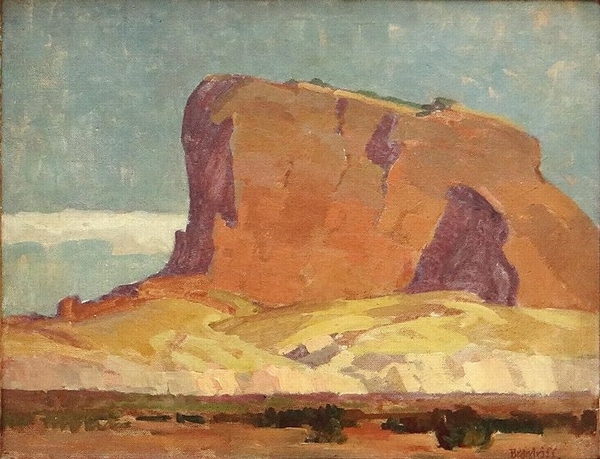
(above: George Kennedy Brandriff, Cly Butte (Navajo for 'left') Monument Valley, Arizona, 1933, oil on canvas board, 14 x 18 inches, American Eagle Fine Arts, Benicia, California. Public domain, via Wikimedia Commons*)
"Pioneer women: Arizona history through art at the Phippen Museum" by Sue Willoughby and Terry Munderloh, from December 1997 monthly archives, Sharlot Hall Museum. Accessed July, 2015
The Prescott Art Community in the 1930s from Andrew L. Christenson. Accessed July, 2015
Rainmakers from the Gods: Hopi Katsinam from Peabody Museum of Archaeology and Ethnology. Accessed July, 2015
Southern Arizona Folk Arts from University of Arizona (University of Arizona Library). Accessed August, 2015.
Spider Rock and the Artists of the American Southwest is a 2026 article by TFAO and Gemini AI whcihg says: "For artists, the physical characteristics of Spider Rock are overwhelmingly compelling. The sheer, towering scale of the monolith provides an unparalleled focal point that commands the eye and anchors the sprawling landscape. The stark contrast between the vertical thrust of the spire and the horizontal spread of the canyon floor creates a natural, dynamic tension in any composition. Furthermore, the texture of the rock -- weathered, fractured, and deeply striated -- allows painters to experiment endlessly with the interplay of light and shadow, particularly during the golden hours of sunrise and sunset when the stone appears to glow from within, shifting from deep red to amber." Accessed 9/26
The Sublime Canvas of the Grand Canyon: American Landscape Paintings from 1860 to 1950 is a 2025 article by Grok 3 which says: "The Grand Canyon, a colossal scar etched into Arizona's earth, has long captivated artists with its unfathomable scale, vibrant colors, and shifting light. From 1860 to 1950, American painters, working in the genres of Tonalism, Impressionism, Post-Impressionism, and Modernism, sought to capture its natural beauty, distilling the canyon's vastness into moments of emotional and visual resonance. These artists, unbound by human intervention in their depictions, focused on the raw, untamed splendor of the landscape. This article explores the contributions of five American artists who painted the Grand Canyon, delving into their cultural inspirations, the influence of their teachers, their technical prowess, and their critically acclaimed works." Accessed 8/25
Visualizing The Sublime: Five Artistic Interpretations of Canyon de Chelly is a 2026 article by TFAO and Gemini AI whcih says: "The American Southwest has long functioned as a crucible for artistic endeavor, offering a landscape where geological majesty intersects with deep cultural history. Among the region's most profound natural cathedrals is Canyon de Chelly, a towering labyrinth of sheer red sandstone cliffs located in northeastern Arizona. For generations, this site has captivated visual artists seeking to translate its overwhelming scale and color intensity into two-dimensional mediums.
By analyzing the works of Ansel Adams, Georgia O'Keeffe, Maynard Dixon, Edgar Payne, and William Robinson Leigh, a complex dialogue emerges regarding how to properly capture the magnitude of the canyon. These five practitioners approached the exact same geography armed with vastly different aesthetic philosophies, ranging from strict photographic documentation and modernist geometric reframing to Impressionist bravura and academic realism. Through their distinct methodologies, they did not merely record a physical location; they actively constructed the visual legacy of the American West, projecting onto its ancient cliff faces their own ideological visions of nature, time, and human resilience." Accessed 9/26
Tucson Desert Art Museum says: "Our mission is to display art and artifacts of the Desert Southwest and surrounding regions, and educate our guests about the history, cultures, and art of the region." Accessed 11/20
Weaving in the Margins: Navajo Men as Weavers from the Museum of New Mexico/Museum of Indian Arts & Culture. Accessed July, 2015
Western Spirit: Scottsdale's Museum of the West, a Smithsonian affiliate museum located in the arts district of Scottsdale, AZ, opened in 2015. The museum offers changing exhibits, including exhibits of contemporary and historic Western art. Accessed February, 2016
Women in the Arts and Architecture, a theme of Arizona Women's Heritage Trail. Accessed July, 2015
Zuni Pottery In the Fred Harvey Era is a 2026 Gemini article which says: "The early twentieth century in the American Southwest was defined by a profound collision between ancient sedentary cultures and the rapid expansion of industrial capitalism. At the heart of this transformation was the Zuni Pueblo, or A:shiwi, a community that had occupied the high desert plateaus of western New Mexico for millennia. For the A:shiwi people, the ceramic arts were never merely decorative; they were functional vessels for water and prayer, manifestations of a matrilineal tradition that linked the physical land to the spiritual realm of the ancestors. However, as the Santa Fe Railway and the Fred Harvey Company began to market the "Indian Country" to a burgeoning class of eastern travelers, the Zuni ceramic tradition underwent a strategic and stylistic evolution. This period, roughly spanning from 1895 to 1940, saw the emergence of a characteristic Zuni style that balanced the demands of a new commercial market -- fueled by the luxury "Indian Detours" -- with the internal necessity of cultural preservation." Accessed March, 2026
Zuni Silversmithing: 1855-1955 is a 2026 Gemini 3 Deep Research report which says: "The evolution of Zuni silversmithing between 1855 and 1955 represents one of the most significant periods of cultural adaptation and artistic refinement in the American Southwest. This era saw the Zuni people transform from masters of ancient lapidary traditions into world-renowned silversmiths, navigating the complex pressures of colonial expansion, the rise of industrial tourism, and the shifting demands of a global art market. To understand this trajectory, one must first recognize the Zuni as a linguistic and cultural isolate, possessing a heritage that reflects deep physical and cultural rootedness in the Colorado Plateau. While their neighbors -- the Navajo (Diné) and the Hopi -- engaged in frequent exchange, the Zuni maintained a core identity that eventually manifested in a style of jewelry entirely distinct from surrounding traditions." Accessed 4/26
 Hearing the Century: Voices of Arizona's Arts Past and Present, from KBAQ 89.5FM - Phoenix,
includes stories about historic Arizona artists. In one segment "Scholar
Betsy Fahlman shares the story of Lon Megargee's Statehood Murals."
In another segment, "Ann-Mary Lutzick, Scholar and Director of the
Winslow Old Trails Museum, shares insights on the vision of one of the southwest's
greatest architects, Mary Colter."
Hearing the Century: Voices of Arizona's Arts Past and Present, from KBAQ 89.5FM - Phoenix,
includes stories about historic Arizona artists. In one segment "Scholar
Betsy Fahlman shares the story of Lon Megargee's Statehood Murals."
In another segment, "Ann-Mary Lutzick, Scholar and Director of the
Winslow Old Trails Museum, shares insights on the vision of one of the southwest's
greatest architects, Mary Colter."
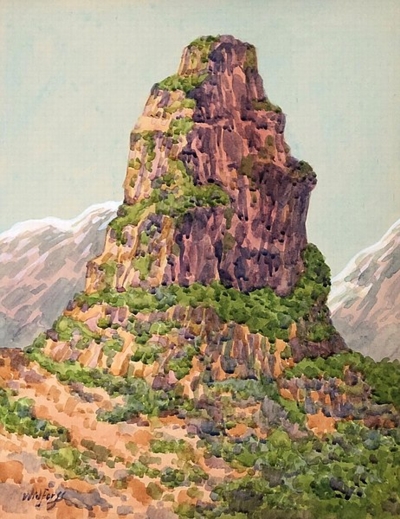
(above: Gunnar Widiorss, Cheops Pyramid, Grand Canyon, watercolor, 12.5 x 9.5 in. Public domain, via Wikimedia Commons)
 Arizona Highways Television
is a series of programs devoted to exploring the highways and byways of
Arizona. The television programs were created in the spirit of Arizona
Highways magazine, a division of the Arizona Department of Transportation.
Arizona Highways Television was created in partnership with The
Arizona Republic. Programs include:
Arizona Highways Television
is a series of programs devoted to exploring the highways and byways of
Arizona. The television programs were created in the spirit of Arizona
Highways magazine, a division of the Arizona Department of Transportation.
Arizona Highways Television was created in partnership with The
Arizona Republic. Programs include:
Accessed May, 2015
Arizona Public Media offers
-- a June 3, 2008 video (05:04) to compliment the exhibit Lee Friedlander: American Monuments May 17, 2008 - August 3, 2008 at the Center for Creative Photography. The exhibit examines national identity as seen by a keen observer. Renowned photographer Lee Friedlander's work on American Monuments explores how we define ourselves. Accessed July, 2015
-- a May 27, 2008 video (05:04) on The Pottery Project. Explore the art of the potter and the science of the archaeologist as Arizona State Museum celebrates 2,000 years of Native pottery-making traditions in the Southwest. At over 20,000 whole vessels, ASM's collection of Southwest Indian pottery is the world's largest and most comprehensive. Eight years in the making, The Pottery Project features the Arnold and Doris Roland Wall of Pots, the Agnese and Emil Haury Southwest Native Nations Pottery Vault, a state-of-the-art conservation laboratory, and a brand new interpretive gallery. The exhibition, in the new gallery, includes a fully interactive, multi-media Virtual Vault; video interviews with archaeologists and Native potters, and hands-on experiences. Accessed July, 2015
-- a April 22, 2008 video (05:39) on Allan Mardon, who left a successful career in commercial illustration to pursue a career in fine art in Arizona. Mardon became inspired by the graphic beauty and history of his new surroundings and began to approach his canvas in an entirely different way. Arts producer Sooyeon Lee has the story. Accessed July, 2015
-- a April 8, 2008 video (05:14) on Neil Bernstein's controversial memorial works (paintings, sculpture and architectural structures) which are exhibited and acquired by museums and collectors throughout the world. The works are historically grounded in world events using an eclectic collision of disparate elements which range from the sacred to the profane. Accessed July, 2015
-- a February 5, 2008 video (05:14) on Louis David Valenzuela. Sculptor Louis David Valenzuela is doing everyting he can do to keep the Yaqui culture alive through his art. Valenzuela's Pascola masks are in the collection of the Arizona State Museum. In this story, you will see how and why he creates those sacred masks. Accessed July, 2015
-- a November 29, 2007 video (03:05) on Cristina Cardenas. Originally from Guadalajara, Mexico, painter Cristina Cardenas explores the disruption of stereotypes of gender, religion and culture through her art work. Accessed July, 2015
NAU-TV's Inside NAU Season 7 Episode 9 features a 3 minute,
46 second video featuring commentary by Fran Elliott and others related
to the exhibition Arizona's
Pioneering Women Artists. Accessed
May 2015.
12/10/18: TFAO wishes to thank Jim Murphy of Tucson, AZ for suggesting new content for this page.
Additional images for Arizona Art History
 Return to Arizona Art History
Return to Individual States Art History Project
*Tag for expired US copyright of object image:

Links to sources of information outside of our web site are provided only as referrals for your further consideration. Please use due diligence in judging the quality of information contained in these and all other web sites. Information from linked sources may be inaccurate or out of date. TFAO neither recommends or endorses these referenced organizations. Although TFAO includes links to other web sites, it takes no responsibility for the content or information contained on those other sites, nor exerts any editorial or other control over them. For more information on evaluating web pages see TFAO's General Resources section in Online Resources for Collectors and Students of Art History.
 Search Resource Library
Copyright 2026 Traditional Fine Arts Organization, Inc., an Arizona nonprofit corporation. All rights reserved.